Continuous-Flow Solid-Phase Peptide Synthesis · CFSPPS™

SYNTHESERACT™

The adaptive peptide synthesis platform.

Chemistry in motion.
Synthesis under observation.
Manufacturing that learns.
Scroll — the machine is awake
PROC · SPRINTΔP 0.42 barUV 1.18 AU
01 · PREMISE
The broken assumption

Peptide chemistry changed.
The machine did not.

For decades, synthesis followed one logic — add reagent, mix, wait, drain, wash, repeat. The chemistry grew ambitious. The molecules grew ambitious. The machine stayed a vessel, a slurry, an agitator and a timer.

Batch SPPS

  • Big tank
  • More solvent
  • Bigger paddle
  • Longer cycles
  • One timer for all chemistry
= more product, blindly

SYNTHESERACT

  • Qualified resin-bed geometry
  • Controlled flow
  • Measured pressure
  • Process intelligence
  • Parallel scale-out
= scalable production, observed

Stop moving the resin through chemistry. Move chemistry intelligently through the resin.

02 · ARCHITECTURE
The new architecture

The chemistry moves.
The machine watches.

Inside SYNTHESERACT the resin stays within a contained reaction bed while precisely prepared chemical streams travel through it. The bed becomes an observable process environment — not a black box with a paddle.

  • P·inPressure entering the reactor bed
  • P·outPressure leaving the reactor bed
  • ΔPDifferential pressure across the resin
  • FlowCommanded flow vs. actual measured flow
  • ThermalInlet, zone and outlet temperature transient
  • OpticalDeprotection and wash-clearance signatures
  • MassReagent consumption, planned vs. actual
  • Δ-modelDeviation between expected and observed behaviour
CFSPPS™ residue cycle
  1. Select building block
  2. Meter reagent
  3. Prepare / activate stream
  4. Controlled mixing
  5. Thermal conditioning
  6. Flow through resin bed
  7. Monitor pressure / flow / temperature
  8. Wash to defined clearance condition
  9. Deprotection
  10. Optical process observation
  11. Next residue

Sequence length is bounded by chemistry, sequence behaviour and cumulative synthesis fidelity — not by an arbitrary software ceiling. A single reagent position can be selected as many times as the sequence demands.

03 · STACK
Three layers · one machine

Prediction. Control. Execution.

SYNTHESERACT is not a single object. It is a stack — an analytical layer that reasons, a control architecture that holds authority and safety, a physical platform that executes, and a process that defines the chemistry.

Dicoias ΨPrediction & process intelligence — sequence risk, historical fingerprints, uncertainty-aware guidanceAnalytical
layer
S3Pulse™Control authority, deterministic machine state, interlocks and safety — the nervous systemControl
layer
SYNTHESERACT™Physical execution — reactors, pumps, thermal system, reagent banks, sensors, fluidicsPhysical
layer
CFSPPS™The chemistry process — continuous-flow solid-phase synthesis, residue by residueProcess
layer
04 · EXECUTION
Three operating personalities

One machine.
Three ways to run.

SYNTHESERACT does not promise a single universal speed figure — scientists would rightly distrust it. It offers operating philosophies. Select one, and the machine's execution changes.

Sprint · high-flow execution

Rapid stream switching, high-flow washing, short process transitions and precise thermal conditioning. Reserved for sequences whose behaviour is already characterised.

    Cycle
    —
    Reagent eq.
    —
    Wash
    —
    05 · SENSING
    The machine can see the resin

    Every residue leaves a fingerprint.

    A residue is not merely an item in a sequence. It is a process event — with a pressure profile, a flow response, a thermal transient and an optical signature. Scrub the chain below; read what the machine reads.

    SEQUENCE · Project P-0148 · 67 residuesREACTOR · Bed 2
    Res 31
    ΔP
    0.44 bar
    Flow
    98%
    Temp
    79.6 °C
    UV area
    1.02
    Clearance
    nominal
    Status
    nominal
    Residue-event memory

    Seen before

    When the same peptide is made again, the machine does not behave as if it has never seen the sequence. Expected ΔP, flow, UV, thermal and clearance profiles — plus authorised recovery strategy — carry forward.

    Automation → intelligence

    Knowledge, not events

    The first successful batch becomes the beginning of process knowledge — not the end of an experiment. That is the difference between automation and manufacturing intelligence.

    Early knowledge

    Failure economics

    A failed early coupling unnoticed for 40 more residues is not only a chemistry problem — it is an economic loss accumulating one expensive cycle at a time. In long-sequence chemistry, early knowledge has financial value.

    Open the Process Explorer Interactive P&ID · coupling / deprotection / wash / guarded idle / abort · residue memory
    06 · SCALE
    Scale the process — not the uncertainty

    Capacity is not one enormous tank.

    The old world scales by enlargement: 5 L → 20 L → 50 L → 100 L. Bigger vessel, bigger agitator, bigger thermal mass, bigger scale-up problem. SYNTHESERACT scales by multiplying qualified geometry.

    Every qualified reactor geometry becomes a unit of scale. Scale-up, scale-out, or a hybrid — capacity grows by repeating what is already understood, not by enlarging what is not.

    07 · REACH
    Long-sequence capability

    The sequence length is not defined by the number of bottles.

    64 physical reagent positions, 128+ logical addresses — because modern chemical peptide synthesis reaches well beyond the standard amino-acid set. The reagent bank is a chemistry library, not a rack.

    20
    residues
    50
    residues
    100
    residues
    150
    residues
    200+
    research config
    Core + stereochemistry

    Beyond the 20

    Standard protected amino acids, D-amino-acid building blocks, orthogonally protected residues, noncanonical monomers.

    Architecture

    Linkers & modifications

    Linkers and spacers for conjugation, lipidation chemistry for compatible development, project-specific building blocks.

    Reserved

    Room to grow

    Reserved positions for proprietary chemistry and future expansion — the library is addressable, and it is not full.

    Practical synthesis performance is sequence- and chemistry-dependent. What the architecture removes is the arbitrary ceiling — the number of positions in the finished peptide is not the number of bottles on the machine.

    08 · CONTROL
    S3Pulse™ · the nervous system

    The machine has a nervous system.

    S3Pulse is not a decorative dashboard. It is the real control architecture — deterministic state, valve sequencing, pump commands, flow verification, thermal control, interlocks, abort sequences, shutdown latch, guarded idle and restart eligibility. It does not merely run the machine. It knows its state.

    Idle
    guarded
    Prime
    stream fill
    Couple
    delivery
    Monitor
    ΔP · flow · T
    Wash
    clearance
    Deprotect
    optical
    Advance
    next residue
    ◈ Pressure protection ◈ Flow verification ◈ Thermal interlock ◈ Abort sequence ◈ Shutdown latch ◈ Guarded idle ◈ Restart qualification ◈ Recipe integrity ◈ Batch integrity

    Above deterministic control, higher analytical layers may advise or adapt — only within explicitly authorised boundaries. Safety and machine authority stay with S3Pulse. No analytical layer overrides an interlock.

    09 · INTELLIGENCE
    Dicoias Ψ · synthesis intelligence

    Prediction before.
    Observation during.
    Memory after.

    Dicoias Ψ does not magically declare a peptide finished. It is the analytical layer that integrates sequence context, known residue interactions, process history, sensor behaviour, observed anomalies and prior outcomes — and reasons about them with its own uncertainty in view.

    Before the run

    Prediction

    Difficult-region prediction, process-risk maps, suggested monitoring intensity — where to watch closely before a single reagent moves.

    During the run

    Observation

    Live comparison against historical process fingerprints; uncertainty-aware intervention guidance surfaced to the operator, never imposed on the machine.

    After the run

    Memory

    Every outcome feeds the next. Batch against batch. Resin lot against resin lot. Reactor against reactor. Knowledge compounds across campaigns.

    10 · ECONOMICS
    Economics

    Speed is valuable.
    Waste is expensive.
    Knowledge compounds.

    Not "saves time and money." Peptide synthesis has specific costs, and SYNTHESERACT attacks specific waste. Here is where the money actually goes.

    11 · RECORD
    Digital Batch DNA

    Every synthesis becomes knowledge.

    Every batch produces a complete, structured manufacturing record — not merely electronic documentation, but comparability. One sequence expands into everything the machine observed while making it.

    Seed · sequence
    P-0148 · 67-mer
    Reactor · recipe
    Bed 2 · r14.2
    12 · MAKER
    The house behind the machine

    Built by Panacea Bio Chem.

    SYNTHESERACT is developed within the Panacea Bio Chem research direction by biochemist and amino-acid-chain designer Bogdan Dicoias — the same house behind the CFSPPS™ process, the S3Pulse™ control architecture and the Dicoias Ψ analytical layer.

    Bogdan Dicoias — biochemist, AAC designer, Director of Panacea Bio Chem
    One house · one doctrine

    Work in silence, publish with boundaries

    Panacea's pattern is consistent across its platforms: name a thing only when the work can carry its own name, describe architecture plainly, and keep performance statements tied to sequence- and chemistry-dependent reality. SYNTHESERACT™, CFSPPS™, S3Pulse™ and Dicoias Ψ are the intellectual property of Bogdan Dicoias.

    Integrity & Quality Profile · IQP ↗
    13 · QUESTIONS
    Questions

    Frequently asked questions

    Platform

    What is SYNTHESERACT?

    The adaptive peptide synthesis platform — the physical execution layer of CFSPPS™: modular resin-bed reactors, pumps, a thermal system, reagent banks, sensors and fluidics, built so the chemistry moves through an observable process environment rather than a black box with a paddle.

    Process

    What is CFSPPS?

    Continuous-flow solid-phase peptide synthesis — the process layer. The resin stays within a contained reaction bed while precisely prepared chemical streams travel through it, residue by residue: meter, activate, mix, thermally condition, flow, monitor, wash to a defined clearance condition, deprotect, advance.

    Control

    What does S3Pulse do?

    S3Pulse™ is the control architecture — deterministic machine state, valve sequencing, pump commands, flow verification, thermal control, interlocks, abort sequences, shutdown latch, guarded idle and restart eligibility. It does not merely run the machine. It knows its state.

    Intelligence

    What is Dicoias Ψ?

    The analytical layer — prediction before the run, observation during, memory after. It integrates sequence context, process history and sensor behaviour, and reasons with its own uncertainty in view. It advises within explicitly authorised boundaries and never overrides an interlock.

    Maker

    Who develops SYNTHESERACT?

    Panacea Bio Chem Ltd — the company of biochemist and amino-acid-chain designer Bogdan Dicoias. SYNTHESERACT™, CFSPPS™, S3Pulse™ and Dicoias Ψ are his intellectual property.

    Scope

    Is this a product datasheet?

    No. This page is an architecture and capability description. Practical synthesis performance is sequence- and chemistry-dependent, and nothing here is medical advice.

    Peptide Synthesis

    How are synthetic peptides made?

    Most research and many therapeutic peptides are assembled by stepwise chemical synthesis. In solid-phase peptide synthesis, the growing chain is attached to an insoluble support while repeated deprotection and coupling cycles add residues in a defined order. The crude product is then cleaved, purified and analytically characterized. — sources: Nobel Prize — Merrifield and solid-phase peptide synthesis, PubMed — Fmoc Solid-Phase Peptide Synthesis

    Peptide Synthesis

    What is solid-phase peptide synthesis (SPPS)?

    SPPS is a method in which the growing peptide chain remains attached to an insoluble resin while amino acids are added sequentially. Because soluble reagents and by-products can be washed away between steps, SPPS simplifies repetitive synthesis and is readily automated. — sources: Nobel Prize — Merrifield and solid-phase peptide synthesis, PubMed — Fmoc Solid-Phase Peptide Synthesis

    Peptide Synthesis

    Why is solid-phase synthesis used for peptides?

    Keeping the peptide attached to a solid support makes repetitive chemistry easier to automate: reagents can be added in excess, then washed away without isolating the growing chain after every step. This greatly reduced the practical difficulty of assembling defined peptide sequences. — sources: Nobel Prize — Merrifield and solid-phase peptide synthesis, PubMed — Fmoc Solid-Phase Peptide Synthesis

    Peptide Synthesis

    What is Fmoc solid-phase peptide synthesis?

    Fmoc-SPPS uses the base-removable fluorenylmethoxycarbonyl group to protect the growing chain’s N-terminus during each coupling cycle. Fmoc chemistry is widely used because deprotection is compatible with automation and the chemistry supports a broad range of peptide sequences and modifications. — sources: PubMed — Fmoc Solid-Phase Peptide Synthesis, PubMed — Advances in Fmoc solid-phase peptide synthesis

    Peptide Synthesis

    What is the difference between Fmoc and Boc peptide synthesis?

    Fmoc and Boc are two protecting-group strategies for peptide synthesis. Fmoc is removed under basic conditions, while Boc is acid-labile. Modern automated SPPS commonly uses Fmoc chemistry, although Boc remains valuable for specialist sequences and applications. The choice changes protecting groups, reagents and cleavage chemistry. — sources: PubMed — Fmoc Solid-Phase Peptide Synthesis, PubMed — Advances in Fmoc solid-phase peptide synthesis

    Peptide Synthesis

    What is peptide synthesis resin?

    Resin is the insoluble polymer support used to anchor the first amino acid and the growing peptide during SPPS. Resin chemistry, linker and loading influence swelling, solvent access, final C-terminal functionality and synthesis performance, so resin choice is a central process variable. — sources: PubMed — Fmoc Solid-Phase Peptide Synthesis

    Peptide Synthesis

    Why does resin swelling matter in SPPS?

    Coupling and deprotection reagents must diffuse through the swollen resin to reach the growing peptide chains. Poor swelling or local aggregation can reduce reagent access and create incomplete reactions. Solvent, resin type, loading and peptide sequence therefore affect synthesis efficiency. — sources: PubMed — Fmoc Solid-Phase Peptide Synthesis, PubMed — SPPS: difficult sequences

    Peptide Synthesis

    What is coupling in peptide synthesis?

    Coupling is the reaction that forms the next peptide bond by joining an activated amino-acid building block to the growing peptide chain. High coupling efficiency is essential because incomplete coupling can create deletion sequences that persist through later synthesis steps. — sources: PubMed — Fmoc Solid-Phase Peptide Synthesis, PubMed — SPPS: difficult sequences

    Peptide Synthesis

    What is deprotection in peptide synthesis?

    Deprotection removes a temporary protecting group so the next reactive site becomes available for chain extension. In Fmoc-SPPS, the N-terminal Fmoc group is removed before each new coupling. Incomplete deprotection can stall or corrupt subsequent synthesis cycles. — sources: PubMed — Fmoc Solid-Phase Peptide Synthesis

    Peptide Synthesis

    What is capping in peptide synthesis?

    Capping deliberately blocks peptide chains that failed to react in a coupling step so they cannot continue growing into closely related deletion impurities. It can simplify downstream impurity profiles, although process strategy depends on the synthesis and desired product. — sources: PubMed — Fmoc Solid-Phase Peptide Synthesis

    Peptide Synthesis

    What is final cleavage in SPPS?

    Final cleavage releases the completed peptide from the resin and usually removes acid-labile side-chain protecting groups at the same time. Cleavage conditions must be chosen to release the target efficiently while limiting side reactions and damage to sensitive residues or modifications. — sources: PubMed — Fmoc Solid-Phase Peptide Synthesis

    Peptide Synthesis

    Why are protecting groups needed in peptide synthesis?

    Amino acids contain multiple reactive functional groups. Protecting groups temporarily mask sites that should not react during a particular step, allowing peptide bonds to form in the intended order. Selective protection/deprotection is what makes controlled stepwise peptide assembly possible. — sources: Nobel Prize — Merrifield and solid-phase peptide synthesis, PubMed — Fmoc Solid-Phase Peptide Synthesis

    Peptide Synthesis

    What is a difficult peptide sequence?

    A difficult sequence is one that becomes poorly solvated, aggregates or forms secondary structure during synthesis, making deprotection and coupling incomplete. Hydrophobic and aggregation-prone sequences are common examples. Difficult sequences often require changes in resin, solvent, temperature, coupling strategy or temporary backbone-disrupting modifications. — sources: PubMed — SPPS: difficult sequences, PubMed — Highly hydrophobic/difficult peptide synthesis

    Peptide Synthesis

    Why does on-resin aggregation reduce peptide synthesis quality?

    When growing chains self-associate on the resin, reactive sites become less accessible to deprotection and coupling reagents. That creates incomplete reactions and more deletion or truncated impurities. Aggregation can therefore make an otherwise routine sequence progressively harder to assemble as it lengthens. — sources: PubMed — SPPS: difficult sequences, PubMed — Highly hydrophobic/difficult peptide synthesis

    Peptide Synthesis

    Why do longer peptides become harder to synthesize?

    Stepwise synthesis compounds small inefficiencies: if every coupling is slightly below quantitative, the fraction of full-length product falls as residue count increases. Longer chains are also more likely to aggregate or form secondary structure. High cycle efficiency and process monitoring therefore become increasingly important with length. — sources: PubMed — Fmoc Solid-Phase Peptide Synthesis, PubMed — SPPS: difficult sequences

    Peptide Synthesis

    What is double coupling and why is it used?

    Double coupling repeats a coupling reaction when a single cycle may not reach adequate conversion. It can improve incorporation of difficult residues or sequences, but it increases reagent use and does not solve every root cause. Monitoring should determine where repetition is actually needed. — sources: PubMed — SPPS: difficult sequences

    Peptide Synthesis

    How can peptide synthesis be monitored during SPPS?

    SPPS can be monitored through signals associated with deprotection or coupling, test reactions, UV absorbance and analytical sampling. Monitoring helps identify incomplete chemistry or the onset of difficult-sequence behaviour rather than discovering the problem only after final cleavage. — sources: PubMed — Advances in Fmoc solid-phase peptide synthesis, PubMed — SPPS: difficult sequences

    Peptide Synthesis

    What is continuous-flow peptide synthesis?

    Continuous-flow peptide synthesis moves reagents through a reaction environment in a controlled flow rather than relying only on repeated batch contact. Modern flow approaches can accelerate heating, mixing, reagent exchange and monitoring, and have been demonstrated from rapid laboratory synthesis to large-scale applications. — sources: PubMed — Continuous-flow peptide synthesis review

    Peptide Synthesis

    How does continuous-flow SPPS differ from batch SPPS?

    In batch SPPS, resin and reagents are mixed for discrete reaction periods before draining and washing. In continuous-flow SPPS, reagents are delivered through or across the resin bed in a controlled stream. Flow can improve heat/mass transfer and automation, but pressure drop, resin behaviour, reagent consumption and scale-up must be engineered carefully. — sources: PubMed — Continuous-flow peptide synthesis review, PubMed — SPPS: difficult sequences

    14 · FIELD
    Trending in the field

    The wider conversation

    SYNTHESERACT™

    Peptide synthesis began as manual chemistry. Then it became automated. The next transformation is not simply faster automation — it is a synthesis system that understands its own process state. Every reagent movement traceable. Every reactor bed observable. Every residue a measurable event. Every batch process memory. And every synthesis teaches the next.

    CFSPPS™ changes the movement of chemistry.
    S3Pulse™ changes the relationship between machine and process.
    Dicoias Ψ changes what can be learned from that process.

    The machine is no longer waiting for chemistry. It is participating in it.

    The Panacea Technology Universe

    26 technologies, each the leader of its class

    Proprietary Panacea Bio Chem Ltd technologies, invented by Bogdan Dicoias — what each one does, and why it leads its class.

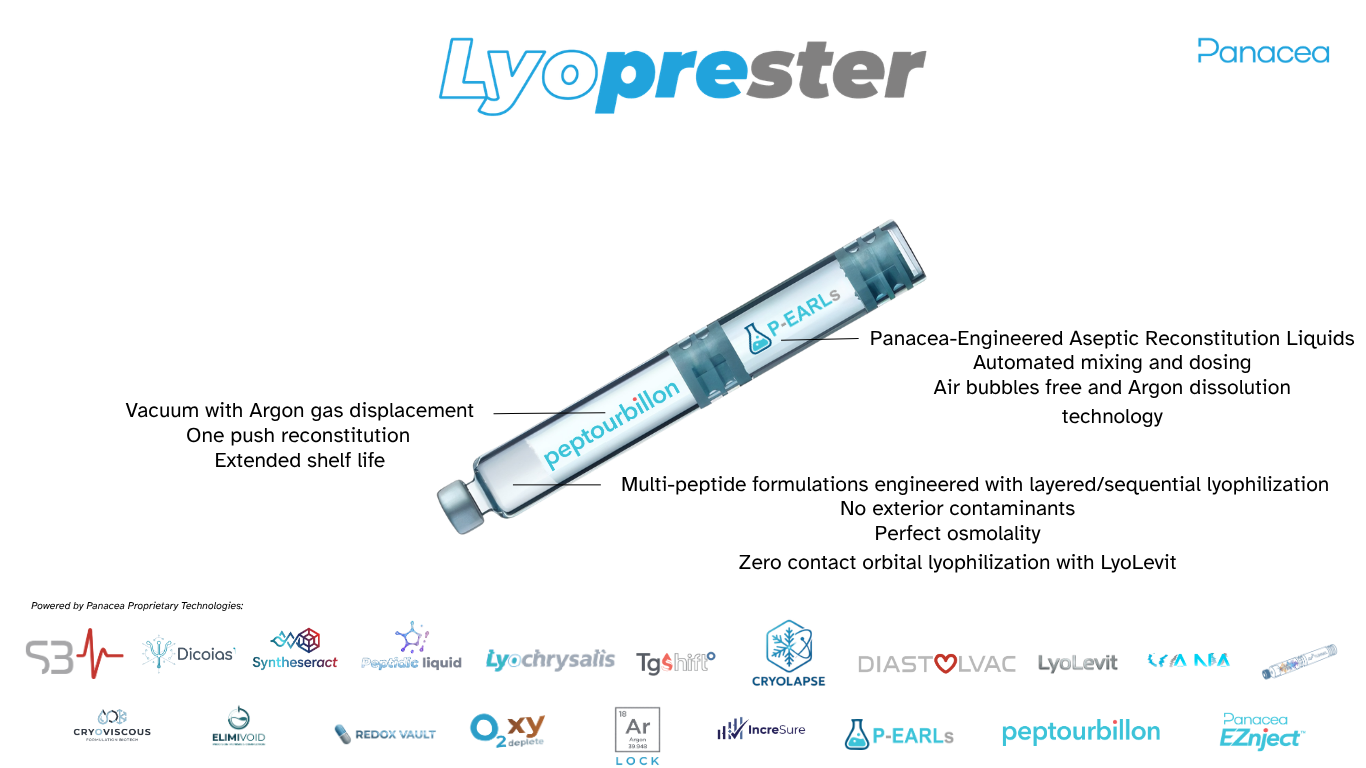
    Lyoprester® technology convergence — the Panacea Bio Chem technologies that meet inside one cartridge, invented by Bogdan Dicoias
    Lyoprester® — Panacea Bio Chem technology by Bogdan DicoiasLyoprester®The only dual-chamber cartridge that is autoreconstitution-enabled, vacuum-sealed and argon-fillback.lyoprester.com ↗P-EARLs — Panacea Bio Chem technology by Bogdan DicoiasP-EARLs™Panacea-Engineered Aseptic Reconstitution Liquid(s) — each tuned to the peptide it wakes.p-earls.com ↗Peptourbillon — Panacea Bio Chem technology by Bogdan DicoiasPeptourbillon™The layered peptide formulation architecture — single- or multi-layer, never a blend.peptourbillon.com ↗RF Tunnel — Panacea Bio Chem technology by Bogdan DicoiasRF Tunnel™The RF-formed central channel through the cake.rftunnel.com ↗TgShift — Panacea Bio Chem technology by Bogdan DicoiasTgShift™Raises the cake’s glass-transition temperature with RF — instead of chilling below it.tgshift.com ↗Cryolapse — Panacea Bio Chem technology by Bogdan DicoiasCryolapse™Cryogenic pressure collapse under S3Pulse™ control — vapour redistributed through the whole cake, not its surface, impeding crust formation.cryolapse.com ↗LyoLevit — Panacea Bio Chem technology by Bogdan DicoiasLyoLevit™The cake levitates and spins in high orbit — driven by ultrasound and RF.lyolevit.com ↗Lyochrysalis — Panacea Bio Chem technology by Bogdan DicoiasLyochrysalis™The integrated chamber housing the whole drying stack.lyochrysalis.com ↗S3Pulse — Panacea Bio Chem technology by Bogdan DicoiasS3Pulse™The control brain for every piece of Panacea hardware.s3pulse.com ↗Liquiprester — Panacea Bio Chem technology by Bogdan DicoiasLiquiprester™The single-liquid cartridge engineered so multiple peptide APIs coexist in one shared vehicle.liquiprester.com ↗Syntheseract — Panacea Bio Chem technology by Bogdan DicoiasSyntheseract™Continuous-flow peptide synthesis in a special, very fast and economical way.syntheseract.com ↗CFSPPS — Panacea Bio Chem technology by Bogdan DicoiasCFSPPS™Continuous-flow solid-phase peptide synthesis, written as its own category.cfspps.com ↗OxyDeplete — Panacea Bio Chem technology by Bogdan DicoiasOxyDeplete™Degassing plus no-headspace doctrine — the oxygen-starved seal.oxydeplete.com ↗ArgonLock — Panacea Bio Chem technology by Bogdan DicoiasArgonLock™The final inert-atmosphere lock under argon.argonlock.com ↗RedoxVault — Panacea Bio Chem technology by Bogdan DicoiasRedoxVault™Separation, not merely suppression — redox isolation in lipid micro-reservoirs.redoxvault.com ↗PleniDose — Panacea Bio Chem technology by Bogdan DicoiasPleniDose™The shared filling gantry — one machine filling both the dual-chamber Lyoprester and the liquid Liquiprester.plenidose.com ↗IncreSure — Panacea Bio Chem technology by Bogdan DicoiasIncreSure™The dose-metrology layer — verified API per pen increment.incresure.com ↗ElimiVoid — Panacea Bio Chem technology by Bogdan DicoiasElimiVoid™Front-void elimination without touching the metered dose.elimivoid.com ↗Cryoviscous — Panacea Bio Chem technology by Bogdan DicoiasCryoviscous™The characterised cold, high-viscosity, low-mobility conditioning state.cryoviscous.com ↗Vana Machine — Panacea Bio Chem technology by Bogdan DicoiasVana Machine™Vacuum–Argon–Nitrogen Architecture — draws the air and nitrogen out of the cake and backfills with argon; in a separate process, the same machine makes the P-EARLs bubble-free.www.vanamachine.com ↗EZnject — Panacea Bio Chem technology by Bogdan DicoiasEZnject™The disposable auto-injector pen built around the Lyoprester.panaceaeznject.com ↗Dicoias Ψ — Panacea Bio Chem technology by Bogdan DicoiasDicoias ΨThe computed-chemistry advisory — every substance reduced to a vector across physical, electronic and formulation space.dcppsi.com ↗SealoPrester — Panacea Bio Chem technology by Bogdan DicoiasSealoPrester™Aseptic Cartridge Closure System — Seal o’ Precision + Sterility.sealoprester.com ↗Peptidic Liquid — Panacea Bio Chem technology by Bogdan DicoiasPeptidic LiquidThe peptide formulation in solution — the active plus its buffers, cryoprotectants, lyoprotectants and scaffolders.peptidicliquid.com ↗DiastolVAC — Panacea Bio Chem technology by Bogdan DicoiasDiastolVAC™Biomimetic diastolic vacuum control — the pneumatic circulatory system of the machine: pumps, valves and sensors as one ensemble.diastolvac.com ↗KineticON — Panacea Bio Chem technology by Bogdan DicoiasKineticON™Motion Integrity Architecture — the motion-control layer that lets the machine know what happened on every axis move.kineticon.org ↗

    This week in the field — 10–16 Aug 2026

    The week's newest publications in "SYNTHESERACT" OR "CFSPPS" — refreshed weekly.

